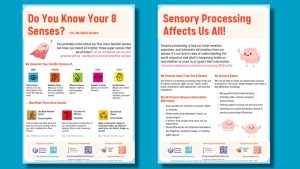
How to use this page:
To explore this page, you can either click on the links below to jump directly to specific sections or scroll down to browse and locate the information you need.
If you can’t find what you are looking for you can also enter a search term in the search bar located in the top right corner.
Overview of Needs
In the UK, SPD is not recognised as an independent diagnosis, and this aligns with the Royal College of Occupational Therapists (RCOT) guidance. They state, “The term Sensory Processing Disorder is not recognised as an independent diagnosis…and should be avoided” (RCOT Informed View, 2021).
Therefore, at the Child Development Centre, we do not formally assess or provide a diagnosis for Sensory Processing Disorder. Our focus is on providing sensory interventions that support a child’s sensory needs by adapting tasks or the environment, and by improving a child’s capacity for self-regulation.
While sensory processing difficulties can significantly impact daily life, there are no formal diagnostic labels or criteria for SPD in the UK. Cerebra organisation recommend focusing on supporting individuals with sensory processing difficulties rather than seeking a formal diagnosis (Find out more here)
Given this context, it would be more appropriate to acknowledge that children may experience sensory difficulties and provide guidance on supporting them effectively. This approach aligns with current UK practices and the recommendations of professional organisations.
To further support schools in creating an inclusive environment, we recommend utilising a Sensory Audit for Schools. This tool helps assess and create environments that enable the participation of pupils with sensory processing differences, focusing on areas such as visual, auditory, and tactile sensitivities. You can access this resource here
What you might notice
Sensory Processing Disorder (SPD) can manifest in various ways in a classroom, as children process sensory information differently. Here are some signs you might notice:
Over-Responsiveness (Hypersensitivity):
To Touch:
- Avoids certain textures (e.g., glue, paint, or rough materials).
- Reacts strongly to accidental touch from classmates.
- Dislikes wearing specific clothing due to seams, tags, or fabric.
To Noise:
- Covers ears or reacts with distress to loud or unexpected sounds (e.g., bells, clapping).
- Struggles to focus in noisy environments.
To Visual Stimuli:
- Easily distracted or overwhelmed by bright lights or busy visuals (e.g., posters or bulletin boards).
- May avoid looking at screens or bright light sources.
To Smells or Tastes:
- Refuses certain foods due to strong preferences for texture or smell.
- Reacts negatively to classroom odours (e.g., markers, cleaning supplies).
Under-Responsiveness (Hyposensitivity):
To Touch:
- Seeks out intense tactile experiences, like squeezing or rough play.
- May not notice dirt on hands, or discomfort from a minor injury.
To Movement:
- Frequently fidgets, swings legs, or seeks opportunities to run and climb.
- Appears clumsy or unaware of personal space.
To Noise:
- Unresponsive to name being called or to classroom instructions unless directly addressed.
- Doesn’t seem bothered by loud noises others find overwhelming.
To Visual or Auditory Input:
- Needs extra prompts to attend to visual cues, like reading from the board.
- Seems drawn to objects with spinning or flashing lights.
Sensory-Seeking Behaviours:
- Frequently touches objects or peers, sometimes inappropriately.
Stands too close to others or leans on them. - Chews on objects like pencils, shirt collars, or erasers.
- Moves constantly, even when seated, by rocking, bouncing, or tapping.
Emotional or Behavioural Signs:
- Difficulty transitioning between activities.
- Easily frustrated, often with outbursts that seem disproportionate.
- Appears overly tired or overstimulated after busy activities.
- Avoids group activities or seems withdrawn during social interaction.
Academic Impact:
- May have difficulty focusing due to sensory distractions.
- Challenges with fine motor tasks like writing or cutting.
- Difficulty following multi-step instructions due to sensory overload.
Strategies
Create a Sensory-Friendly Environment
Reduce Visual Clutter:
- Keep classroom decorations simple and organised.
- Avoid overly bright or crowded bulletin boards.
Minimise Noise:
- Use noise-cancelling headphones, sound-dampening materials (like rugs or curtains), or soft background music for calming effects.
Adjust Lighting:
- Provide natural light when possible or allow students to use sunglasses or hats if sensitive to bright lights.
Provide Sensory Breaks
Offer “sensory breaks” to help regulate students’ arousal levels. Examples include:
- Using a quiet corner or sensory room.
- Allowing time to engage in movement activities, like walking, jumping, or stretching.
- Incorporating breathing exercises or mindfulness techniques.
Flexible Seating Options
Alternative Seating:
- Use wobble stools, exercise balls, or cushions to provide subtle movement.
Standing Options:
- Allow students to stand at their desks or use standing desks if needed.
Defined Space:
- Give personal space with clear boundaries (e.g., carpet squares, lap desks) to reduce sensory overload.
Provide Sensory Tools
Fidget Tools:
- Offer stress balls, putty, chewable necklaces,
Resources Interventions and Activities
- Occupational Therapy (OT) & Sensory Integration Therapy
- Therapeutic Activities
- Proprioceptive Input (pushing, pulling, weighted activities).
- Vestibular Input (swings, balance boards, rolling).
- Tactile Desensitisation (gradual exposure to different textures).
- Handwriting & Fine Motor Support
- Adapted grips, slant boards, or textured paper.
- Hand-strengthening exercises (playdough, tweezers)
Further Reading & Support
Links will open in a new tab, Word Documents will download to your device