
How to use this page:
To explore this page, you can either click on the links below to jump directly to specific sections or scroll down to browse and locate the information you need.
If you can’t find what you are looking for you can also enter a search term in the search bar located in the top right corner.
Overview of Needs
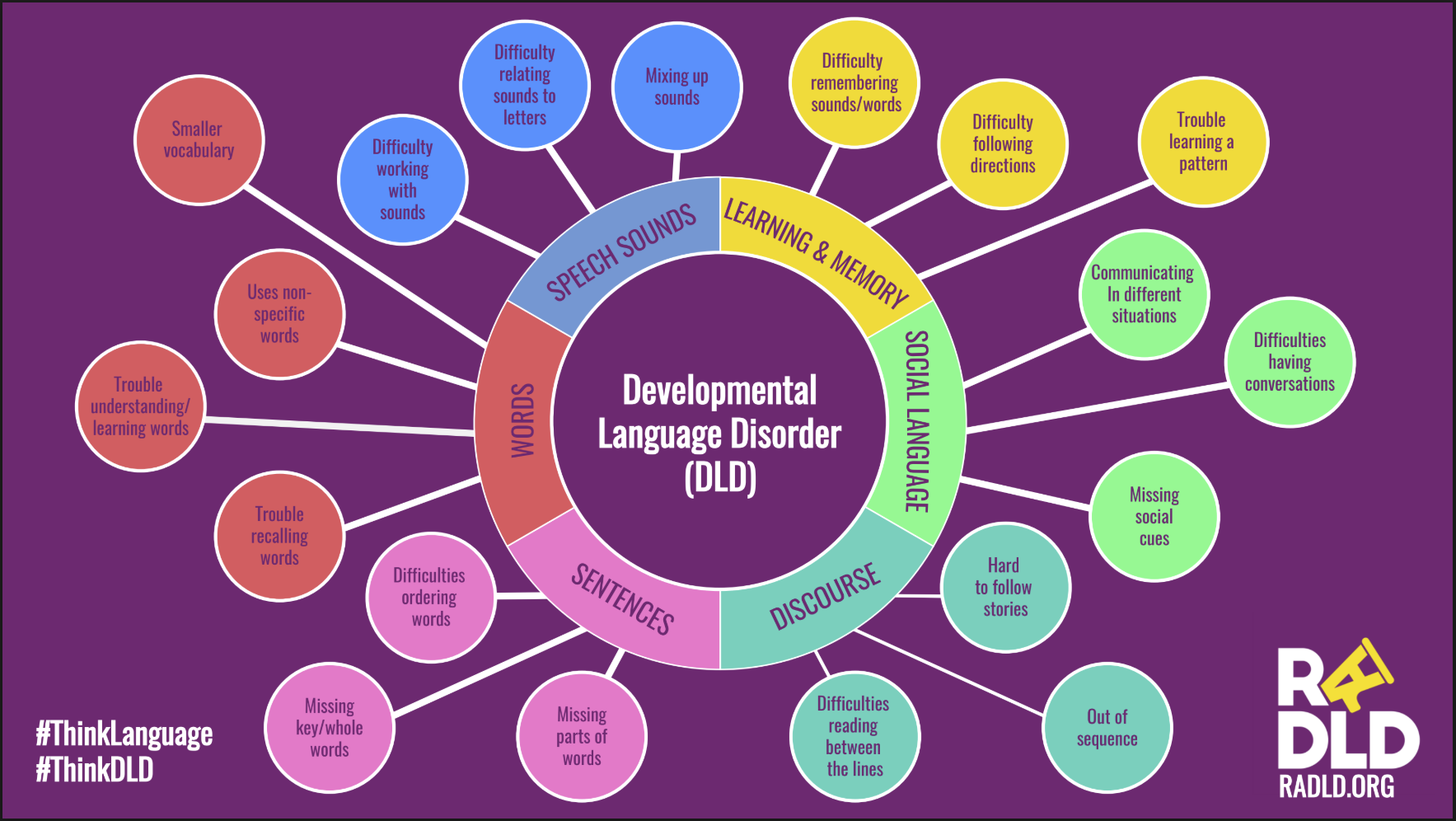
Developmental Language Disorder (DLD) is a lifelong condition that affects the ability to understand and/or use spoken language. Children with DLD have specific needs that require tailored support in academic, social, and communication contexts.
What you might notice
1. Communication Challenges
a. Receptive Language (Understanding)
Difficulty Following Instructions:
- Struggles to understand multi-step instructions or complex language.
- May need instructions repeated or simplified.
Delayed Response:
- Takes longer to process verbal information and respond appropriately.
Limited Understanding of Abstract Language:
- Difficulty with idioms, jokes, metaphors, or figurative language.
b. Expressive Language (Speaking)
Limited Vocabulary:
- May have a smaller vocabulary compared to peers.
- Struggles to find the right words or may use vague terms.
Short or Simple Sentences:
- Tends to use shorter, simpler sentences (e.g., “I go park” instead of “I am going to the park”).
Grammar Errors:
- Frequent use of incorrect tenses or missing grammatical structures (e.g., “He go” instead of “He goes”).
Difficulty Forming Sentences:
- Struggles to organize thoughts into coherent, grammatically correct sentences.
c. Speech Clarity
Pronunciation Issues:
- Problems pronouncing certain sounds or words clearly, making speech hard to understand.
Speech Hesitation:
- Often pauses or hesitates when speaking, as they struggle to find the correct words.
2. Academic Difficulties
a. Reading Challenges
Slow or Difficult Reading:
- May struggle with decoding words, reading fluently, or understanding what they’ve read.
Difficulty with Reading Comprehension:
- Difficulty recalling key details, understanding main ideas, or answering questions based on the text.
b. Writing Struggles
Poor Spelling and Grammar:
- Frequent spelling errors, even with simple words, and challenges with grammatical structure.
Disorganised Writing:
- Difficulty organizing ideas logically in writing, leading to poorly structured essays or assignments.
c. Word Problems in Math
Difficulty with Math Language:
- Struggles with understanding and solving word problems due to challenges with language comprehension and math vocabulary.
3. Social and Emotional Indicators
a. Social Communication Difficulties
Difficulty with Conversations:
- May struggle to initiate or maintain conversations, often missing social cues (e.g., taking turns in conversation, understanding facial expressions).
Limited Social Interactions:
- May avoid group activities or social interactions due to frustration with communication difficulties.
Difficulty Understanding Social Cues:
- Struggles with non-verbal communication, such as body language, facial expressions, or tone of voice.
b. Emotional Impact
Frustration and Anxiety:
- Experiences frustration, embarrassment, or anxiety when trying to communicate.
- May appear withdrawn or anxious in situations that require verbal interaction or explanation.
Low Self-Esteem:
- May feel self-conscious about their communication challenges, leading to a lack of confidence.
4. Behavioural Observations
Increased Dependence on Visual Aids:
- Prefers visual supports (pictures, gestures) or written instructions over verbal communication.
Frequent Requests for Clarification:
- Frequently asks for instructions to be repeated or explained in a simpler way.
Frustration When Tasks Are Verbal:
- May become visibly frustrated or give up on tasks that require verbal communication or comprehension.
5. Long-Term Observations
Delayed Speech Milestones:
- Earlier signs of DLD can include late speech onset, difficulty pronouncing words, or limited use of vocabulary for their age.
Academic Struggles Persist:
- These difficulties may continue throughout schooling, especially with subjects involving reading, writing, or verbal communication.
Compensatory Strategies:
- Over time, students may develop strategies to cope with their language difficulties, such as relying on gestures, drawings, or asking peers for help.
Strategies
Communication Strategies
a. Receptive Language (Understanding)
Simplify Instructions:
- Use short, clear sentences with one instruction at a time.
- Repeat or rephrase if needed.
Visual Supports:
- Pair spoken words with visual aids like pictures, symbols, or gestures.
Check Understanding:
- Ask students to repeat instructions or summarize key points to ensure comprehension.
Pre-Teach Vocabulary:
- Introduce new words and their meanings before lessons or activities.
b. Expressive Language (Speaking)
Model Language:
- Provide correct examples by gently rephrasing or expanding on what the student says.
Example: If they say, “Want apple,” respond with, “You want an apple.”
Encourage Communication:
- Provide sentence starters or prompts to help the student initiate responses.
Allow Extra Time:
- Give students time to process their thoughts and respond without rushing them.
Use Alternative Communication:
- Introduce Augmentative and Alternative Communication (AAC) tools, like
- PECS (Picture Exchange Communication System), if verbal expression is significantly challenging.
2. Academic Strategies
a. Reading and Writing
Scaffold Reading Tasks:
- Use visual aids, such as story maps or graphic organizers, to help students understand text.
Phonics and Word Recognition:
- Provide explicit instruction in phonics to improve decoding skills.
Writing Supports:
- Use writing frames, sentence starters, and graphic organizers to help organise thoughts.
- Offer alternative methods for assignments, such as oral presentations or typing.
b. Task Presentation
Chunk Information:
- Break complex tasks or instructions into smaller, more manageable parts.
Multi-Sensory Teaching:
- Use hands-on activities, visuals, and auditory cues to reinforce learning.
Provide Context:
- Relate lessons to real-life scenarios or familiar concepts to make abstract ideas more concrete.
c. Classroom Environment
Consistent Routines:
- Maintain predictable routines to reduce anxiety and support understanding.
Visual Schedules:
- Use pictures or written schedules to outline the day’s activities.
3. Social and Emotional Strategies
a. Social Skills Development
Teach Social Scripts:
- Provide scripts for common social interactions, such as greetings, asking for help, or joining a group.
Role-Playing:
- Practice social scenarios in a structured setting to build confidence.
Explicit Teaching of Social Cues:
- Use videos or real-life examples to explain facial expressions, tone of voice, and body language.
b. Building Confidence
Celebrate Successes:
- Focus on strengths and provide positive reinforcement for small achievements.
Encourage Participation:
- Offer low-pressure opportunities for the student to speak or engage in class activities.
c. Emotional Regulation
Teach Emotional Vocabulary:
- Help students identify and express emotions using words, visuals, or symbols.
Coping Strategies:
- Teach calming techniques like deep breathing, counting, or using a sensory tool.
Resources Interventions and Activities
- Role-Playing & Social Scripts – Teach expected language for different social situations (e.g., greetings, requesting help)
- Turn-Taking & Conversation Games – Activities that encourage waiting, listening, and responding appropriately.
- Comic Strip Conversations – Drawing interactions to help children understand social cues and language use.
- Emotion Vocabulary Development – Teaching emotional words with visuals and real-life examples to support emotional expression.
Further Reading & Support
Links will open in a new tab, Word Documents will download to your device

